"You're Not Using AI. You're Using a Chatbot."
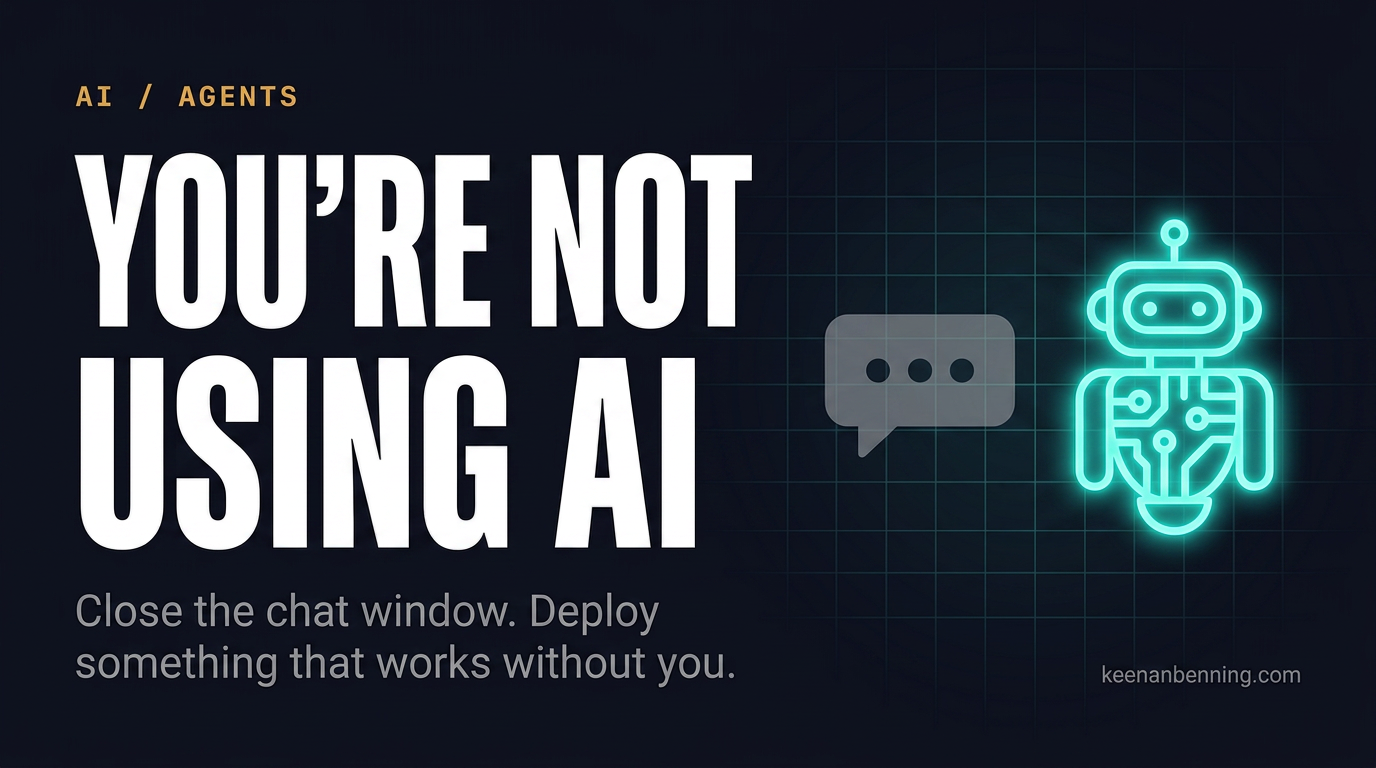
Everyone's comparing ChatGPT to Claude like it's Ford vs Chevy. That's the wrong question. The real gap isn't between models. It's between chatbots and agents.
Everyone is having the wrong conversation about AI.
I see it every day.
Reddit threads, LinkedIn posts, group chats.
"Which is better, ChatGPT or Claude?"
People comparing response quality like they're picking a phone plan. Swapping screenshots of outputs. Running the same prompt through four models to see who writes the better email.
That's like test-driving Ferraris in a parking lot. You're measuring the wrong thing entirely.
The question isn't which chatbot is smarter. The question is what happens when you stop.
KB
What a chatbot actually is
Strip away the branding and a chatbot is a text box that talks back.
You type something. It responds.
You type again. It responds again.
When you close the tab, it forgets you. When you go to sleep, it does nothing. When you wake up, it's sitting there waiting for your next message like a golden retriever staring at a tennis ball.
ChatGPT, Claude, Gemini. At the chat layer, they all work the same way.
You push. They respond. You stop pushing. They stop.
That's not an employee. That's not even a tool. It's a really expensive autocomplete that requires your constant attention to produce anything useful.
Every minute you spend in that chat window is a minute you're doing the work yourself with a fancy assistant looking over your shoulder.
You're the bottleneck. The AI is just making the bottleneck slightly faster.
What an agent actually is
An agent doesn't wait for you to type.
It has memory. It knows what happened yesterday and what's supposed to happen tomorrow.
It takes action. Not "here's a draft you can copy-paste."
It sends the email. It pulls the report. It watches for the signal. It runs the workflow. While you sleep.
Here's the difference in practice.
A chatbot can write you a great follow-up email to a lead.
An agent sends that email automatically 90 seconds after the lead fills out your form, personalized to their answers, at 2am on a Saturday while you're at dinner.
A chatbot can summarize a dataset if you paste it in.
An agent pulls fresh data every morning, runs the analysis, flags anomalies, and drops a brief in your inbox before you've made coffee.
A chatbot can draft a social post.
An agent manages your entire content pipeline, research, drafting, scheduling, cross-posting, and only pings you when something needs a human decision.
The chatbot is reactive. The agent is proactive.
That's not a small difference. That's a category difference.
The intern vs. the specialist
Think about it this way.
A chatbot is a really smart intern who only works when you're standing over their shoulder.
You walk away, they stop. You come back, they need the context explained again. They're brilliant when you're directing them. But they produce exactly zero output on their own.
An agent is a specialist who runs their function 24/7.
You don't micromanage a specialist. You give them the objective, the constraints, and the authority to execute. They report back when there's a decision only you can make. Otherwise, they handle it.
Nobody scales a business on interns. You scale on specialists who own their domain.
The people comparing ChatGPT to Claude are arguing about which intern is smarter.
The people deploying agents already left that conversation.
But not all agents are built equal
Here's the part nobody's telling you.
Now that the agent conversation is finally happening, a second wave of platforms is racing to sell you a fleet of generic agents on top of someone else's cloud model. Lindy. Sintra. Cassidy. Howie Liu's autopilot pitch. Drag, drop, deploy. Looks slick in the demo.
Then you put it in front of a real business and it falls apart.
The model under the hood is rented from a Cloud Landlord. OpenAI, Anthropic, Microsoft, Google. They run it. They throttle it. They quietly degrade it behind the same monthly fee. AI pickpocketing. The tool that worked Monday changes Tuesday and nobody told you. You're paying the same price for a worse engine and you find out by watching your output get dumber.
The output is what I call vibe slop. Looks impressive in a screenshot. Can't actually run inside a real business. The agent doesn't know your customer. Doesn't know your offer. Doesn't know how you talk, what you charge, who you say no to, or why your last hire didn't work out. So it produces generic output dressed up as personalized output. Confident. Wrong.
You've already seen vibe slop. The same purple-gradient AI flyer your barber, your dentist, and your kid's soccer coach all posted last week. The LinkedIn and Facebook posts that all read identical: same "here's what nobody tells you about X 👇" hook, same three bullets, same CTA, same cadence. The cold emails that all open with "I hope this finds you well." Different businesses, same output. You scroll past it every day.
Now imagine that running inside your business. That's not an agent that runs your business. That's a chatbot in a costume.
The operator who fires their team and tries to run the company on a fleet of generic agents doesn't become a CEO of the future. They become an AI-Janitor CEO. Drowning in pull requests they didn't write, hallucinations they didn't catch, customer messages going out in a voice that isn't theirs. All day, every day, cleaning up after a swarm of agents that don't actually know the business.
The fix is the part nobody else is doing.
Before you deploy an agent, you have to extract the operator. The Interviewer Agent sits with you and pulls out what's already in your head: the workflows, the decision logic, the way you actually talk to a customer at 11pm when they're upset. That's the brain. Then we drop that brain into an agent.
Now the agent isn't generic. It's you, at scale.
You start on cloud models because that's what works today. But the brain is yours. When local hardware catches up (and it's catching up faster than people think), you graduate to local. Same agent. Same brain. Now running on infrastructure you own. Same today, tomorrow, a year from now. Nobody can pickpocket the engine because you're holding the keys.
That's what I mean when I say sovereign AI. An agent that knows your business, belongs to you, and behaves the same on Tuesday as it did on Monday.
If the agent isn't built from your knowledge and you don't own where it runs, you don't have an agent. You have a rental that's about to get worse.
What this actually looks like
Let me tell you what my Monday morning looks like.
I wake up around 6. Make coffee. Open my phone.
There's a message from my research agent. It ran at 5am while I was asleep. Crypto markets moved overnight. Sage already pulled the signals, flagged two positions worth watching, and dropped a summary in my inbox. I didn't ask for it. It just runs.
Next to it, a content brief. My marketing agent scanned industry news, identified three stories relevant to my audience, and drafted angles for each one. Not garbage AI slop. Structured analysis filtered through my brand voice and positioning. I'll review it over coffee and approve what works.
Then I check the engineering queue. A feature I scoped yesterday afternoon is already built. My build agent picked it up, wrote the code, ran its own review against six quality gates, fixed two issues it found, and pushed to staging. There's a summary of what changed and why.
It's 6:15am. I haven't opened a laptop yet.
I still don't fully believe it some mornings. I'll be standing in the kitchen reading a build summary and think: a year ago I would have been three hours into this and nowhere close to done. Now it's finished before sunrise. That feeling doesn't go away. It just gets quieter.
I run two platforms solo. No engineering team. No content team. No research analyst. The kind of operation that would have required the equivalent of a 15-20 person team two years ago now runs on one person directing agents.
That's not a projection. That's my Tuesday.
And it's not just business operations.
I'm learning Spanish. Not with Duolingo. With an agent that adapts to my level, remembers what I got wrong last Thursday, and runs conversation practice that actually feels like talking to a patient tutor who never gets frustrated.
I track markets. Not by staring at charts. With a research agent that watches my positions and only interrupts me when something actually matters.
None of this required me to be a linguist or a trader. The agent is the expert. I just had to know what problem I was solving.
The people who already moved
The model doesn't matter nearly as much as what you do with it.
A mediocre model running as an agent that executes while you sleep will outperform the smartest chatbot on earth that sits idle 23 hours a day.
Fred runs a dry cleaning business. Not a tech company. A dry cleaning business.
He'd never built anything with AI before. But he had a problem: leads were coming through his website contact form and he kept missing them. By the time he'd check his email and respond, the customer had already called someone else.
So he deployed an agent. Wired it to his contact form. Now when someone submits an inquiry at 11pm on a Wednesday, the agent responds in 90 seconds with a personalized follow-up. His first week, three leads that would have gone to competitors turned into booked jobs. Fred built American Cleaning around that agent. It's live right now.
The agent didn't come out of a template. We sat Fred down with the Interviewer Agent first and pulled the way he actually talks to a customer who calls at 11pm: the questions he asks, the prices he quotes, the small things that make people pick him over the chain down the street. Then we dropped that into the agent. It doesn't sound like a bot. It sounds like Fred.
Lisa works in tech sales. Also not a developer. She had an idea for a product but no way to build it and no budget to hire someone.
She used her agent to build Fancyfied, launched an ebook, and wired the agent to her Whop store. The first morning after launch, she opened Telegram to a message from her agent: four sales overnight, all while she was asleep. She'd never shipped a product before. Now she had customers before breakfast. The business runs while she sleeps.
Lisa's agent didn't ship as a generic store bot. It got built off her calibration interview: her brand voice, her offer logic, how she handles a hesitant buyer at 1am. The agent inherits that. It's not selling like Lindy. It's selling like Lisa.
Colette runs Mind Indulgence. Hand-poured aromatherapy: essential oils, custom blends, sprays, bath bombs, body butters. Small batch, artisanal, calming. The least techy operation you can picture. We built her site for her using cypher.camp's AI Studio, then handed her a cypher.camp agent that runs the site updates and her Whop store. She ships the oils. The agent ships everything else. Mind Indulgence is live.
None of them wrote a line of code. None of them waited until they felt ready.
They just stopped comparing chatbots and started deploying agents.
The question
If you're reading this, you're probably using AI already. Maybe you use ChatGPT for drafting emails. Maybe Claude helps you think through problems. Maybe you bounce between three different tools trying to find the best one.
That's fine. That's where most people are.
But now you know there's another level. A level where the AI doesn't wait for you to type. Where it works while you sleep, learns what you need, and handles the parts of your business that eat your time but not your talent.
The gap between knowing that and doing it is smaller than you think.
You don't need to become an AI expert. You don't need to learn to code. You need to know what problem you're solving, define the outcome clearly enough for an agent to execute it, and evaluate whether the output is right.
Direction and evaluation. That's the whole skill.
We are not in the era of the Autonomous Employee. We are in the era of the Amplified Operator. Your top human doesn't get fired and replaced by a generic agent fleet. Your top human gets extracted into an agent that acts like them at scale. You go from one of you to ten of you. That's the win. The other path? Fire the team, run a swarm of generic agents on rented models, hope it holds together. That's the AI-Janitor CEO. We're not building that.
If you're curious what this looks like in practice (how non-technical people are deploying agents that actually sound like them, run real businesses, and don't get quietly degraded by a Cloud Landlord), cypher.camp is where I built it all. Same infrastructure. Same agent framework. We give you the keys.
Close the chat window. Deploy something that works without you.
Agentic & distributed systems, DeFi, and the compute economics. One email a week, no fluff.
Subscribe to the newsletter →About the author
Keenan Benning is the founder of cypher.camp, a platform that deploys AI agent teams for solo founders and small businesses. One person. Team-scale output. 60 seconds to deploy.
Other projects