The One-Person Unicorn Is Already Here
How I build and run two technology platforms as the sole engineer with AI agents, vibe coding, and cloud infrastructure. The age of the generalist is now.
You don't need to be an expert. You need to build one.
I build and run two technology platforms as the sole engineer. One is a 5-domain AI skill acquisition engine. The other is an NSF-backed workforce infrastructure system architected for 100,000+ users. No engineering team. No outsourced dev shop.
Just me, AI agents, robust testing, and cloud infrastructure.
Sam Altman predicted AI would create the first one-person billion-dollar company. I'm not waiting for someday. I'm already building like this.
KB
Two platforms. One engineer.
cypher.camp is where non-technical and technical people alike come to build and train their own AI agent teams. 45+ courses, a personal AI tutor, and a full content studio powered by every major model.
Members deploy their first agent in 60 seconds. The done-for-you path goes further: I scope and build a dedicated agent system around your business, then deploy a cYpher.claw trained specifically on your work. The same infrastructure I built for myself, available to anyone.
DeFi All Odds is an NSF-backed workforce infrastructure platform I built as sole engineer and CTO. While a part of a small leadership team, every line of code, every deployment, every integration is me.
Multi-portal system with real-time monte carlo assessment engines, architected for 100,000+ concurrent users.
Across both: Frontend on Vercel. Backend microservices on Azure. Auth through Clerk and Auth0. Email through Resend. Every major AI model integrated. One engineer.
Two years ago this would have required 15-20 engineers. Today it takes 1-5 people who know how to direct AI agents.
And I'm not the only one. A single engineer built OpenClaw, an open source computer-use agent that exploded to 180,000+ GitHub stars. One person. It moved Cloudflare's stock price. It caused Mac Mini buying panics. Then OpenAI acquired the creator and announced they'd support the project going forward.
One person built something that an entire AI lab wanted to own.
This isn't a fluke. It's a pattern.
The gold rush nobody sees
We are in the middle of a gold rush. Most people are looking at the wrong thing.
They're watching AI replace jobs and panicking. Debating whether AI will "take over." Meanwhile, the biggest building opportunity since the internet is sitting right in front of them.
Vibe coding changed software development. What the printing press did for books, vibe coding will do for software. I describe what I want in natural language. AI writes the code. I review, adjust, ship. What used to take a week takes an afternoon. I'm not a 10x engineer. I'm a 1x engineer with 10x tools and 10x effort.
AI automation changed operations. Email sequences, content generation, data analysis, customer onboarding, lead generation. Agents handle the repetitive work. I handle strategy and decisions.
Cloud engineering changed infrastructure. Clerk provides auth. Vercel deploys globally in seconds. Azure scales on demand. I don't manage servers. I manage architecture.
This isn't just true in software. When OpenAI announced GPT-5.2 "derived a new result in theoretical physics," the actual paper told a different story. Human physicists defined the problem, derived the initial results by hand, and wrote the validation criteria. GPT-5.2 spent 12 hours brute-forcing a simplification until it passed the humans' tests.
It was a super-powered calculator, not an autonomous scientist.
Same pattern as vibe coding: the tool amplifies, the human directs.
Stack these together and one person can build what used to require a funded startup.
The day of the expert is over
For decades, the career advice was: specialize. Go deep. Become the world's best at one narrow thing.
That advice is dead.
If the work requires computer use of any kind, it can be offloaded to an AI agent.
AI agents are better specialists than humans. They know every framework and every language. They don't forget. They don't get tired. The bottleneck is no longer "do you know how to code this?" It's "do you know what needs to be built, and can you evaluate whether it's correct?"
What AI can't do is see the full picture. It can't decide that the marketing copy needs to match the onboarding flow which needs to reflect the pricing strategy which needs to align with the course content.
It doesn't know that Nicki Minaj is no longer invited to the cookout. That requires a generalist who understands every layer of the business and culture.
The world will be owned by AI orchestrators. Not experts who know one thing deeply. Generalists who know enough about everything to orchestrate the whole system. Whose only specialty is quality prompt work.
The orchestrator model
When Altman talks about a one-person billion-dollar company, he's not talking about a genius coder alone in a basement.
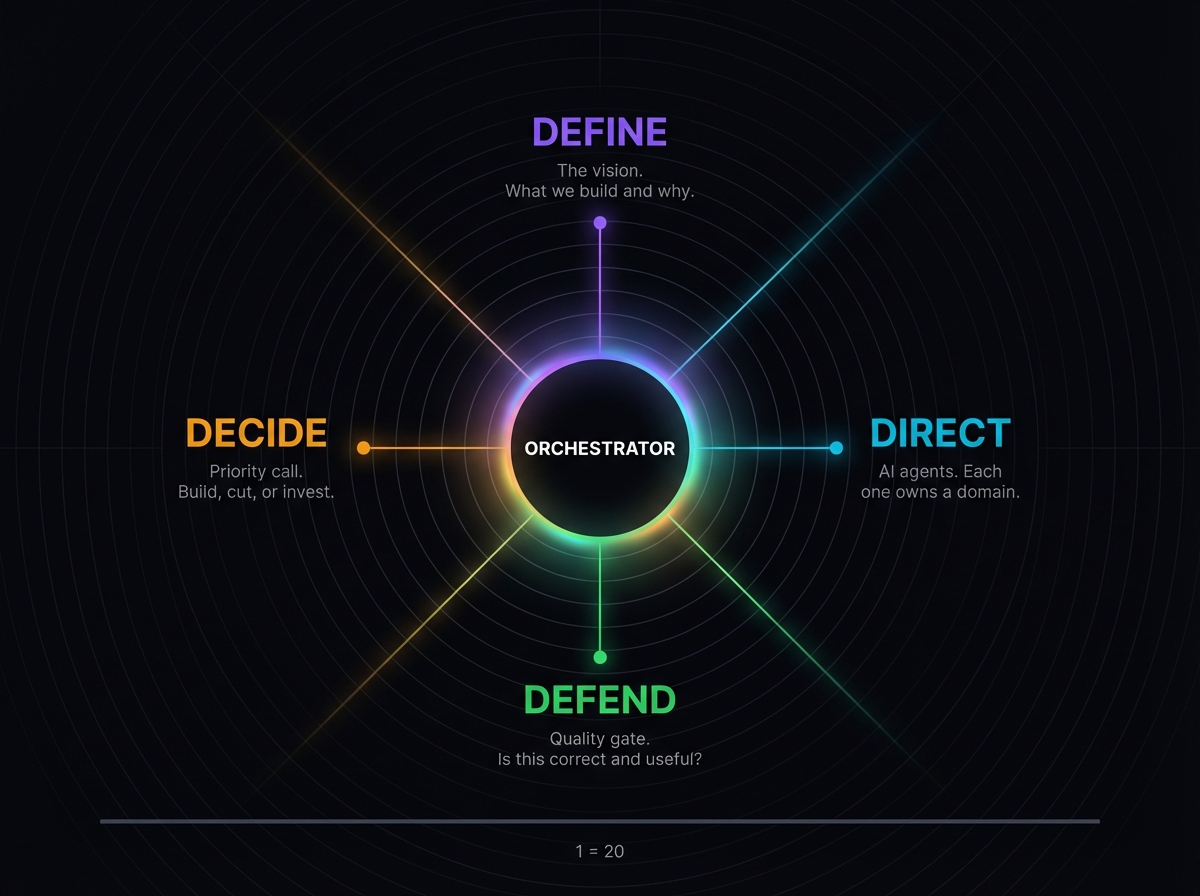
He's talking about an orchestrator. Someone with a repeatable operating model for directing AI agents across every domain of a business.
My operating model has four parts: Define the outcome clearly enough that an agent can execute it. Direct the right agent to the right task. Defend the output: review, critique, and reject anything that misses. Decide what ships. That's it. Define, Direct, Defend, Decide.
It governs everything across code, copy, design, data, and ops. It's the reason one person can build and run what used to require a funded team. It's the same reason one engineer behind OpenClaw could build something that an entire AI lab wanted to acquire.
The infrastructure is already here. The AI models are already capable. Cloud platforms already scale to millions. The only missing piece is people who know how to operate the system.
The stack
Here's what I actually use. No abstraction, no marketing.
Claude Code and Codex via OpenClaw ACP build the product. I describe what needs to be built. The agent writes it, tests it, and ships it. I review and approve. That's the whole cycle.
OpenClaw runs my personal AI agent swarm. Five agents, each with a defined role:
- Orion is my chief of staff. Every task filters through him first.
- Forge is my engineer. He takes the build brief and directs Claude Code.
- Sage is my research and intel layer. Every morning, Sage pulls market signals, competitor moves, and content opportunities without me asking.
- Solara owns brand and content. She drafts newsletters, social posts, and articles.
- Scout is QA. Before anything reaches me, Scout reviews it. Nothing ships without Scout's sign-off.
They run while I sleep. They report to me when work is done. I wake up with a brief, not a to-do list.
n8n handles all automation. When someone completes the our assessment, n8n catches the webhook, scores the responses, and routes them automatically. Builder fit gets a personalized follow-up in 60 seconds. Done-for-you fit gets a message with a booking link. The right message reaches the right person before they close the tab. Zero manual work.
Vercel, Azure, Clerk, Resend handle the infrastructure. Frontend deploys in seconds. Backend scales automatically. Auth is handled. Email is handled. I manage architecture, not servers.
Claude, GPT, and Gemini are all integrated into cypher.camp's AI Studio. Members get access to every major model from a single interface.
That's the stack. Total monthly cost is a fraction of one full-time hire.
You don't need to build it yourself
In 2019, building this kind of infrastructure required a skeleton crew. Minimum $300K per year in salary alone, before tooling, cloud, or benefits. Most people couldn't start. They had to raise money or stay employees.
In 2026, the same infrastructure runs for around $500 per month with the right stack.
You don't need to be an expert. You need to deploy one.
That's not a metaphor. That's the literal product.
cypher.camp is that stack, productized. The infrastructure I built for myself, packaged so anyone can access it. I have non-technical professionals on the platform right now building agents for trading research, real estate analysis, social work tools, and business intelligence. No code required.
Two paths depending on where you are:
Builder. You want to learn. Choose the current cYpher.camp membership that fits your needs, build your own agents, own everything you create, and develop the skill set that compounds over time. Best for people who want to understand the system, not just use it.
Done for you, scoped per project. You want it done. We build your agent system around your business. Every engagement includes a dedicated cYpher.claw agent trained specifically on your work and deployed specifically for you. The first month is included in setup; continued service starts at $99+/month.
Both paths include full agent access and the cypher.camp AI Studio.
The gap between "I want to do this" and "I'm running this" used to be a full engineering team and a venture check. Now it starts with a scoped conversation.
What members are actually building
A social worker on the platform built an app for youth group therapy sessions. No code. AI agents generate session plans based on intake notes, track participant progress week over week, and surface relevant intervention resources for each kid.
She runs it solo. It handles the administrative load that used to eat half her working hours.
A member runs trading research across multiple tickers every morning before market open. Agents pull data, run comparisons, flag anomalies, and surface signals. He reviews a summary. What used to take two to three hours now takes twenty minutes of attention.
A musician and a fashion designer are using agents to run the business side of their creative careers. The musician's agents monitor playlist placements, pitch to blogs and curators, and draft outreach emails.
The designer's agents track trend signals, research suppliers, and manage wholesale inquiry follow-up. Both of them were spending 20+ hours a week on tasks that had nothing to do with their actual craft. Now they spend those hours making things.
One user took the AI Workflow Automation Playbook course and built the missed-call text-back from Module 1, the first workflow in the stack. He pitched it to a cannabis delivery company that same week. Built it live on the call, just like the course shows. The owner paid him $1,200 on the spot. He hadn't even finished the course yet.
Another member used the app builder to redo her entire personal website over a weekend. New copy, new design, landing page for her ebook. She made 5 sales on launch day. 50 sales in 2 weeks. Two years of procrastination, gone in 48 hours.
None of them are trying to build the next billion-dollar company. They're trying to add $2K, $5K, $10K a month to what they already do. That's what this is really for.
The skill that matters now
The barrier to "technical" is lower than it has ever been. The latest generation of AI models can write production code, generate marketing copy, and analyze data at a level that would have required three separate hires two years ago. The ceiling moved up and the floor dropped out at the same time.
What matters now is AI orchestration. Not "prompt engineering." Not memorizing which model scores best on benchmarks. The skill is knowing what needs to be built, routing the right agents to build it, and knowing when the output is wrong. Prompt engineering is chapter one. Agent orchestration is the whole book.
The people who learn to direct these systems will build things that would have been impossible five years ago. The ones who don't will keep wondering how one person shipped what their team of 20 couldn't.
Where to start
Most people overcomplicate the entry point.
You don't need to understand every model. You don't need to learn to code. You need to know what problem you're solving and have a clear enough picture of the outcome to evaluate whether the agent got it right.
That's the whole skill. Direction and evaluation.
A $100K per year solo business is not a moonshot. It's a math problem. You need the right stack, a clear problem to solve, and the ability to direct agents well enough to deliver real output. Most people are closer than they think.
Take the free assessment at cypher.camp/assessment. It will show you exactly where you are and what to build first. No pitch. Just a clear starting point.
Agentic & distributed systems, DeFi, and the compute economics. One email a week, no fluff.
Subscribe to the newsletter →About the author
Keenan Benning is the founder of cypher.camp, a platform that deploys AI agent teams for solo founders and small businesses. One person. Team-scale output. 60 seconds to deploy.
Other projects