Apple Just Built the Render Farm
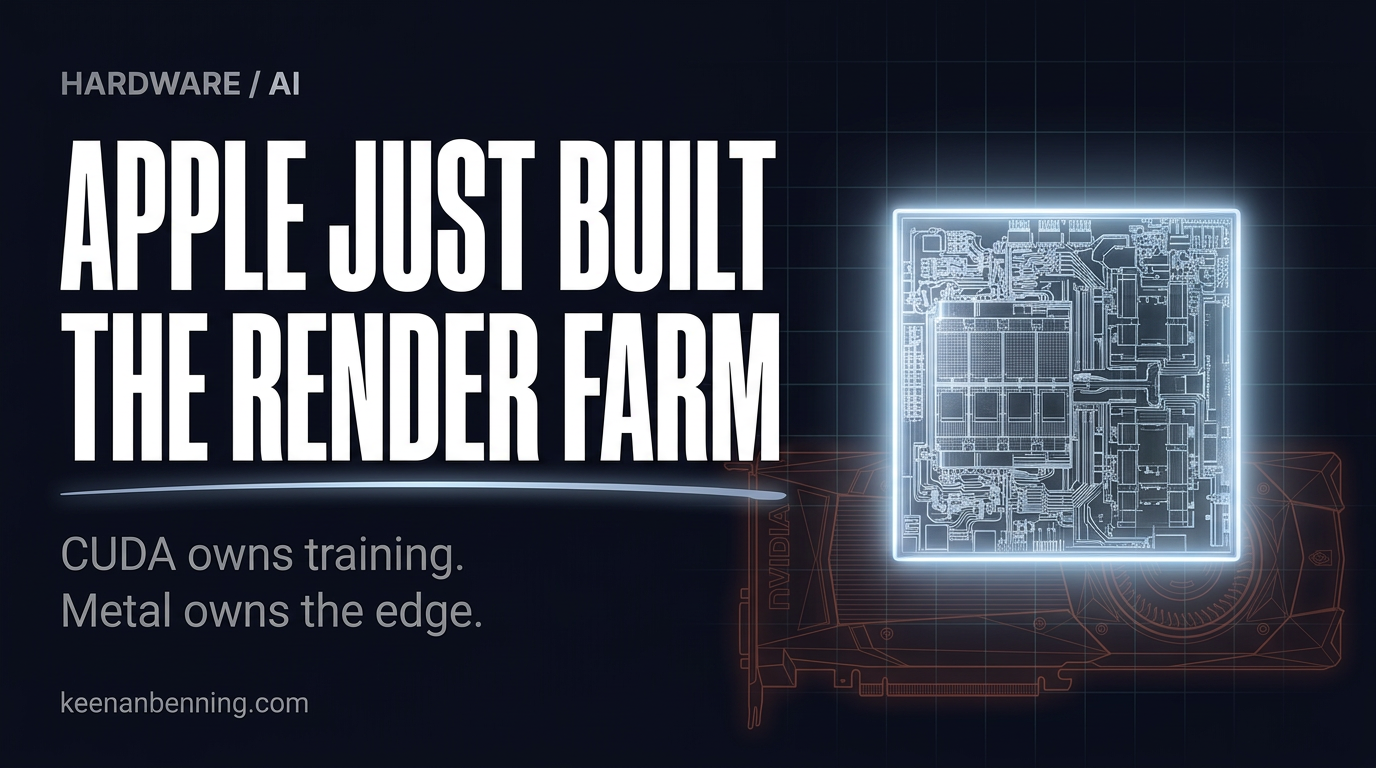
A maxed-out M5 Ultra costs $278 a month. Cloud GPUs doing the same work cost $36,000. Apple just made Nvidia's monopoly irrelevant for everyone who runs AI instead of training it.
I ran the math on a Tuesday.
$5 per GPU hour on AWS. One AI agent running 24/7 for 30 days. That's $3,600.
Just to keep one agent alive.
Ten agents: $36,000 a month. And that's before you hit rate limits, before your cloud provider decides their internal products need the GPU more than you do, before the price shock I've been tracking for a year actually lands.
Then Apple announced the M5 Pro and Max, and the math flipped.
KB
Microsoft is building a mountain. Apple is handing you one.
Every dollar Microsoft and Google are pouring into data centers is the same bet: your AI lives in their building, runs on their hardware, and you pay every time it thinks.
That model made sense when AI was a chatbot. It breaks when AI is an agent.
A chatbot uses 500 tokens and waits for you. An agent runs loops. Research, write, verify, revise, repeat. In the background while you sleep.
I wrote about this in The AI Compute Crisis Is Here: a single agentic workflow can burn more tokens in an hour than a human uses in a month. Scale that to ten agents. Multiply by the team Microsoft is selling Copilot to.
The cloud AI model is a tax on continuous execution. And like all taxes, the people with the least leverage pay the most.
Apple's M5 changes who pays.
The number that stopped me
A maxed-out M5 Ultra Mac Studio costs around $10,000. Amortized over three years, that's $278 a month.
Cloud GPU equivalent: roughly $5 per hour.
One agent running continuously at $5/hour: $3,600 per month. Ten agents: $36,000.
The M5 Ultra, doing the same work, sitting on your desk: $278 a month. Fixed. Forever.
Same work, 130x cheaper.
And the marginal cost of every inference call you run locally? Zero. Not cheap. Not subsidized. Zero.
If an agentic workflow needs 500,000 tokens to complete, running it locally costs you electricity. Running it on OpenAI costs $25 to $37.50 at current pricing. Run ten of those a day and you're looking at $3,000 a month in API costs before you've built anything real.
This is the escape hatch.
Apple's M5 doesn't solve the supply chain problem. It makes it irrelevant. When your compute lives on your desk, the grid crisis is someone else's problem.
Nvidia built a 20-year software moat. Apple decided not to need it.
MacBook laptops are already outperforming $2,000 Nvidia GPUs for local AI workloads. Consistently. In side-by-side benchmarks.
Yet Nvidia is worth $3 trillion and gets all the developer attention.
The reason has nothing to do with hardware. The reason is CUDA.
CUDA is Nvidia's proprietary development platform. It's been the standard for AI programming for nearly 20 years. Every AI researcher, every PhD student, every developer who learned to train models learned on CUDA.
The libraries, the tools, the frameworks, the careers. All of it runs on Nvidia.
The moat is cultural, not technical. Switching away from CUDA isn't a software decision. It's an ecosystem problem. We're talking about 20 years of institutional knowledge, billions in tooling, and an entire generation of developers who literally don't know another way to build.
Apple cut ties with Nvidia in 2018 and moved GPU development in-house. At the time, it looked like they were locking themselves out of the AI race. No CUDA support. No developer ecosystem. No compatibility with the dominant tools.
But they weren't trying to beat Nvidia at the data center game. They built something called Metal. And they were building for the next game entirely.
Two eras. One transition.
The CUDA era was built for one purpose: training massive models from scratch, across thousands of clustered GPUs, in server farms running for months at a time.
That's where CUDA is dominant and will stay dominant. If you're OpenAI burning $100M in compute to train a frontier model, you're using CUDA. That era belongs to Nvidia.
But inference is different. Inference is running the model.
Every time an agent executes a task, every time code gets suggested, every time a workflow fires.
Inference is where the volume lives. It's where the marginal cost problem lives. It's where agentic loops run 24/7. And inference is where Metal wins.
Bandwidth.
In a standard PC setup, the GPU is a separate card plugged into the motherboard. Data travels from system memory, across the PCIe bus, into the GPU's own memory before the chip can use it. That transfer is a bottleneck.
The GPU spends a meaningful chunk of its time just waiting.
Apple's M-series chips have no bus to cross. CPU, GPU, and Neural Engine all read from one memory pool. The M4 Pro moves data internally more than four times faster than a comparable Nvidia card can receive it externally.
Nvidia waits. Apple doesn't.
Memory.
A high-end Nvidia consumer GPU ships with 16GB or 24GB of VRAM. Load a model bigger than that ceiling and it crashes. Hard stop.
Apple's unified memory has no such limit. The M5 Ultra's 512GB is one shared pool. CPU and GPU reach it simultaneously. A 70 billion parameter model that won't fit in any Nvidia consumer card runs in the M5 Ultra with room left over.
Power.
Running inference on an Nvidia GPU draws 150 to 300 watts. The card alone runs hot enough to heat a room.
The M5 Pro does comparable local AI inference at 20 to 30 watts. Less than a standard lightbulb.
That matters for a laptop. It matters more for an agent running 24/7. And it matters enormously when you scale to the device mountain Apple is building: hundreds of millions of chips doing continuous AI inference, on battery, at zero marginal cost per call.
CUDA owns the training era. Apple is building for the inference era.
Monopolies don't innovate. They consolidate.
Nvidia is a monopoly. CUDA gave them 20 years of developer lock-in and a market cap that briefly surpassed every company on earth.
A chip company. Briefly the most valuable business in human history. Let that land.
But monopolies have a predictable pattern: once they win the market, they stop solving problems and start protecting the position.
Apple isn't trying to beat Nvidia at the data center game. That's not the play.
The play is to make the data center game irrelevant for most developers. Move inference to the edge. Kill the API cost. Kill the latency. Kill the data sovereignty problem. And stop exporting the environmental cost to people who never signed up for it.
Data centers consume 3-5 million gallons of water per day for cooling and draw 100-300 megawatts of power per facility. They're not being built in wealthy suburbs. They're going up in Arizona, Oregon, Virginia. Rural and low-income communities that end up with spiked electricity bills, depleted water tables, and zero access to the AI running inside the buildings.
I wrote about this in depth. The economics are brutal. The geography is not an accident.
Every inference call you run locally costs you watts. Cents on your electricity bill. No water. No permit fight. No community meeting where residents are asking why their electricity rates went up 15% so a tech company could train a model they'll never use.
The environmental case for local AI is just as strong as the economic one. It just doesn't show up in the benchmark comparisons.
And suddenly, for the solo builder running agentic workflows on a Mac, CUDA is simply not in the equation.
And the tooling is catching up. Open-source frameworks like Ollama already let developers run full production AI models on Apple Silicon with zero cloud dependency.
A standard MacBook is now a complete AI development machine from day one.
Build, test, run, ship. No Nvidia GPU. No AWS account. No credit card attached to a billing meter watching every token.
The Orchestrator doesn't need to raise VC funding to rent H100s in a server farm. They need an Apple device.
Stop feeding your moat to strangers
Every time you paste your internal research, your customer notes, your proprietary workflow into an OpenAI prompt, you're handing the thing that defines your edge to a system you don't own, built by a company that is also your competitor.
I've been building two production platforms solo for years. The edge isn't the code. Anyone can build the code now. It's the accumulated context.
Every decision that worked, every workflow burned in the hard way, every judgment call that's impossible to articulate but obviously right. That context is specific to me. And it's vulnerable the moment it leaves my machine.
Local AI on M5 hardware means your most sensitive data never crosses a network boundary. You fine-tune on your own corpus. You run inference on confidential client data. The thing that makes you irreplaceable stays with you.
Data sovereignty is a competitive moat.
Latency is a creativity tax
Round-trip to a cloud API and back: 200 to 800 milliseconds on a good day. More when the model is at capacity. More when rate limits kick in.
That delay is invisible when you're drafting one email. It's crippling when you're iterating in a creative loop. Generate, judge, revise, generate again. Ten times in a row.
The Orchestrator's value is taste. The ability to know the difference between output that's technically correct and output that actually lands.
That judgment gets exercised in real time, in rapid iteration, against a constant stream of generated material.
You can't apply taste at 400ms latency. You can at zero.
When the machine responds in real time, the loop between intent and output collapses. Local inference doesn't just change the cost. It changes how you think.
The thesis is on schedule
Last month I wrote that 2028 isn't when AI gets powerful. It's when power gets cheap.
Apple's M5 roadmap validates that timeline from a different direction.
M1 to M5 in five years. Each generation pushing more model complexity onto a smaller chip, running cooler and cheaper per inference. And that compounding isn't tied to TSMC's Arizona fab timeline or a data center permit or a power grid approval in Virginia.
Microsoft and Google are betting on centralization. Bigger. More power. More square footage. Capital expenditures measured in years and building permits.
Apple is betting on distribution. Not data center mountains. Device mountains.
Hundreds of millions of chips in pockets and on desks, each one capable of running serious inference, permanently owned, with zero marginal cost per call.
The future is dozens of smaller models, each tuned for a specific job. An animation model. An Excel model. A code review model. A financial analysis model.
Purpose-built, domain-specific, running locally. We're already seeing it. Every month the open-source community ships another fine-tuned model that beats GPT-4 on a narrow task and runs on a MacBook.
And that's where Nvidia's story gets uncomfortable.
512GB of unified memory running three or four specialized models simultaneously, each one fast enough for real-time work, none of them needing a data center. If the future is task-specific models small enough to fit on a desk, Apple wins outright.
Nvidia goes back to being what it was before CUDA made it a monopoly: a gaming company that sells graphics cards.
(I know that sounds dramatic. Nvidia still owns training. But training is the shrinking part of the pie. Inference is the part that scales to every person on earth.)
When compute gets distributed, the moat stops being infrastructure. It becomes judgment and workflow design.
And that's what every issue of this newsletter has been about.
The render farm is real
In There Is No Plan, I wrote about the animator who spent three months drawing frames while AI generated a full three-minute fight scene in a single day.
His critique was perfect: the pacing is wrong, it's not cohesive, it doesn't understand storyboarding.
The AI had infinite execution and zero taste. He had the taste and was still measuring his value in frames per hour.
He was holding the moat and couldn't see it.
The render farm I described. One person with taste and a machine that never sleeps. That configuration ships from Apple's website now.
For $278 a month, amortized: 512GB of unified memory, enterprise inference, data sovereignty, zero marginal cost per token. Owned outright. Running on Metal. Outside Nvidia's ecosystem entirely.
The Orchestrator role isn't a thought experiment. Neither is the hardware.
2028 is when the factories catch up and the economics normalize for everyone. We're building the positions now.
Agentic & distributed systems, DeFi, and the compute economics. One email a week, no fluff.
Subscribe to the newsletter →About the author
Keenan Benning is the founder of cypher.camp, a platform that deploys AI agent teams for solo founders and small businesses. One person. Team-scale output. 60 seconds to deploy.
Other projects