The Incubation Period
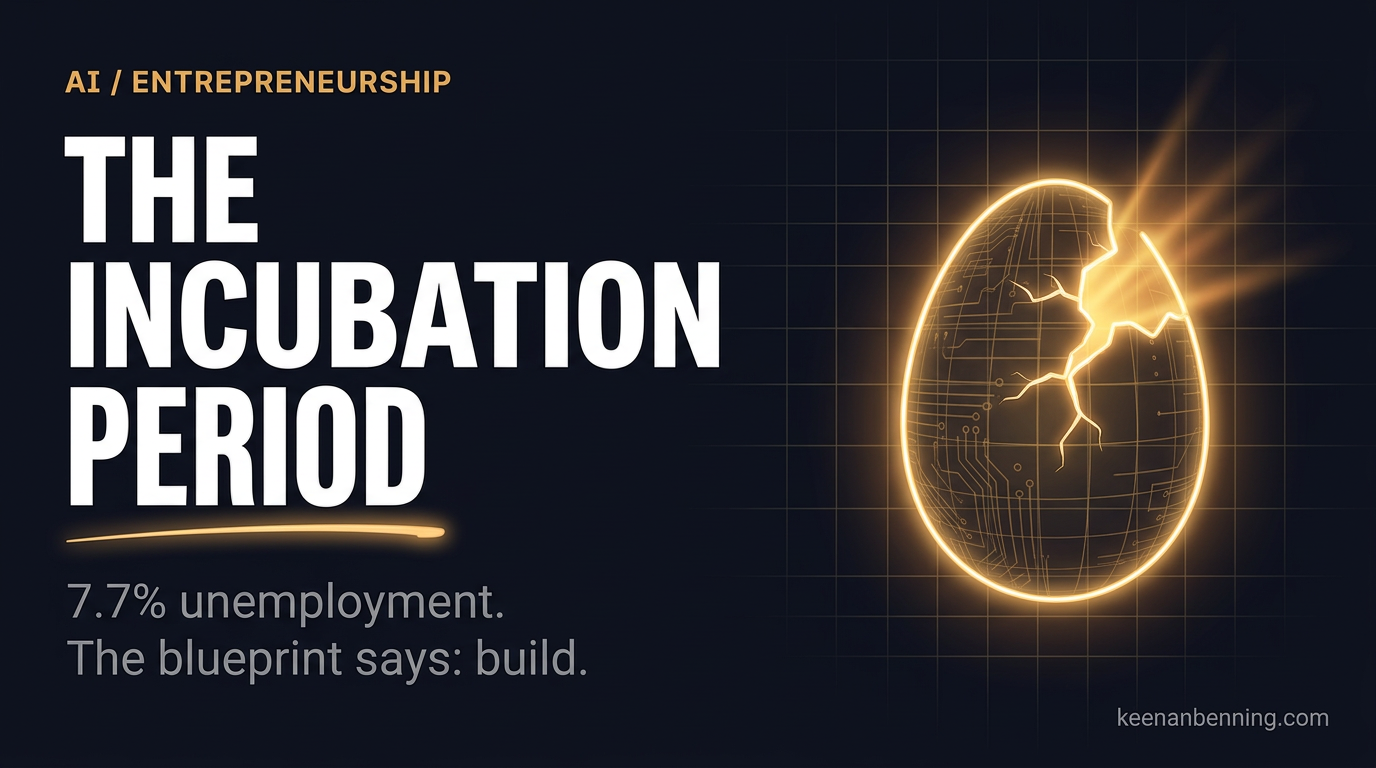
Black unemployment is not a verdict on Black possibility. Building something of your own is one response, but cheaper tools don't erase the cost of getting there.
7.7%.
That's the Black unemployment rate for February 2026, as reported in the Joint Center's analysis of the BLS release. To the economist, that's a data point. To the parent staring at bills at 11pm doing division that doesn't divide, it can feel like a verdict.
White unemployment was 3.7%. Same economy. Different experience. But you already knew that. Last hired. First fired. I don't look at that gap and see a failure of individual ambition. I see a country that still hasn't made opportunity equal.
I'm not here for the eulogy. I'm here to talk about what we can build without pretending the loss of a paycheck is good news.
KB
Beyond the headline
Black people build businesses. We don't need a layoff to discover that about ourselves.
The Census Bureau's estimates for 2022 counted 194,585 Black-owned employer businesses, with $211.8 billion in annual receipts and 1.6 million employees. These are firms with paid employees, not every Black-owned business or everyone working for themselves. Receipts aren't take-home income. And a business count from 2022 doesn't cancel an unemployment rate for a different population in 2026.
What it does give us is a fuller picture of Black economic life. There is ownership here. There are people making things, serving customers, and paying other people to work. I want that in the story without asking a newly unemployed person to turn next month's rent into an inspirational business story.
The system says you're out. You say bet.
I still believe in that response. I just don't want the slogan doing the work that money, time, and support have to do.
Three phases
The incubation period has a structure. I didn't see it until I lived it, but looking back, I can separate preparing, producing, and making the work sustainable. That's a way to think about the process, not a timetable everyone has to follow.
Phase 1. Incubation. The check stops, or the work you've been doing stops looking secure. That first month can be terrifying. No argument. The ideas you shelved because you were too busy start looking different. The side project you never had time for gets another look.
Preparation is not failure. Neither is applying for another job. If a steady paycheck gives you room to build without gambling the rent, that's useful. Taking care of your family isn't evidence that your imagination has gone soft.
“What could I build with what I already know?” can sit beside the job search. It doesn't have to replace it.
Phase 2. Activation. You picked a problem and produced something. Maybe you use an agent to collect public research for a report. Maybe the useful tool is a spreadsheet. You have something to show a person who might need it, and something to check against what they actually asked for.
A polished report with bad sources doesn't clear that bar. The work has to help someone, and you have to be able to stand behind it.
Phase 3. Deployment. Someone pays for the work, and you find out what delivering it really costs. That includes your time, revisions, finding the customer, and fixing mistakes. An API bill is one expense. It isn't the whole business.
A first sale gives you evidence. Repeat customers and enough income after expenses give you stronger evidence. Replacing a lost paycheck is a goal, not the entry requirement for calling this progress. You may also learn that this particular offer doesn't work. That is a reason to keep the first attempt small enough to learn from.
The cost that changed
I can ask an AI tool for help with a draft, research, code, or a plan. That gives me more ways to get an idea far enough along to test it. Some parts of starting are cheaper and more accessible than they used to be. It doesn't follow that software has replaced a salaried team or given me every skill needed to judge its work.
One person at a kitchen table in Detroit should be able to attempt more without first raising enough money to hire a team. That's the possibility I'm excited about.
An agent can help prepare outreach. Someone still has to understand the buyer. It can draft financial projections. Someone still has to defend the assumptions. It can help write code. Someone still owns what that code does to a customer's data.
When money is tight, a lower cost of trying matters. I want to use that room to find out whether an idea is useful before spending more on it. Buying access to a model doesn't answer that question. A customer might.
Finding the customer
I'm not going to pretend this is easy. I didn't believe it was possible myself until I was actually doing it. I'm still not great at the sales part. I'd rather build than pitch. That's a limitation I'm working on. Being able to make something and being able to sell it are different skills.
It's why I keep coming back to the buyer's actual problem. Find a task you understand, learn where the current process breaks, and make that part work better. Knowing a customer's routine may matter more than knowing the name of every new model.
There is work between having access to a model and making it useful inside a business. On March 12, Anthropic announced its Claude Partner Network, offering training, technical support, and joint market development to organizations helping enterprises adopt Claude. The company sees value in implementation support. That doesn't mean every independent consultant has a waiting market.
A small operator might serve a customer a large consultancy wouldn't take on. A smaller scope, less overhead, and direct access to the person doing the work can be advantages without pretending the services are equivalent. I would rather make a promise I can check than sell “enterprise-grade” output because an agent can produce a long document.
The voice you have to name
There's also the question of whether you see yourself as someone who gets to do this at all.
Du Bois described double consciousness in The Souls of Black Folk: “always looking at one's self through the eyes of others.” I apply that idea here to the weight of being told you're not the type of person who builds a company. The safe path is the only path. Keep your head down. Be grateful for what you had.
Structural exclusion doesn't just restrict access to jobs. It can shape what you think you're allowed to want. I don't want to accept that limit.
Childcare, healthcare, debt, discrimination, and the need to eat are not mindset problems. A shrinking runway can make experimentation harder, not magically make a person fearless. Asking people to build can't mean blaming them when they can't afford the risk.
The answer can't only be individual hustle. It also has to include access to capital, people willing to make introductions, customers willing to buy, and room to learn without one mistake destroying a household. If we're serious about Black ownership, support has to mean more than applauding the finished business.
I want more of us to see ourselves as builders. I also want us to have a real chance to build.
A first attempt
If you're in the incubation period, start with a skill you already have and a problem someone actually needs solved. Writing, analysis, design, operations, whatever. Talk to that person before building a complicated system for them.
Say the useful thing is a research report. Agree on the question it needs to answer, then make a small sample you can show, explain, and correct. Use public information for the sample. Use AI where it helps; do the work another way where it doesn't. Private client information needs permission and an understanding of where it goes before you put it into a service.
I build cYpher.camp, so I have a stake in people finding these tools useful. You don't need to buy from me to test this idea. Start with what you have and set a limit on the time and money you can spend without threatening what you need to live.
Before quoting a price, include your labor and revisions, not only the software. Being smaller than a consulting firm doesn't obligate you to be cheap. The customer is paying for useful work you can stand behind.
Find out whether someone will pay for that limited offer. If they won't, ask why. If they will, deliver it and learn what needs to change before you promise it again. You now have something to judge besides whether the tools look impressive: did the work help, and can you afford to keep doing it?
The call
The problem of the twenty-first century is not the color line alone. It is who owns the tools on either side of it.
Cheaper tools don't make those sides equal. They do give us something worth testing, and something worth fighting to keep accessible. I don't want Black workers described only as the people an economic shift happens to. I want ownership in the picture, too.
That 7.7% deserves a response from employers and institutions, not just a motivational speech to the people carrying it. We can demand better from them and still make room for something of our own.
Being pushed out should not get to decide what you're capable of building.
Agentic & distributed systems, DeFi, and the compute economics. One email a week, no fluff.
Subscribe to the newsletter →About the author
Keenan Benning is the founder of cYpher.camp, CTO of DeFi All Odds, and a forward-deployed AI systems engineer. He builds AI systems and writes about the engineering, economics, and ownership questions behind them.
Other projects