The Cost of Software Just Hit Zero
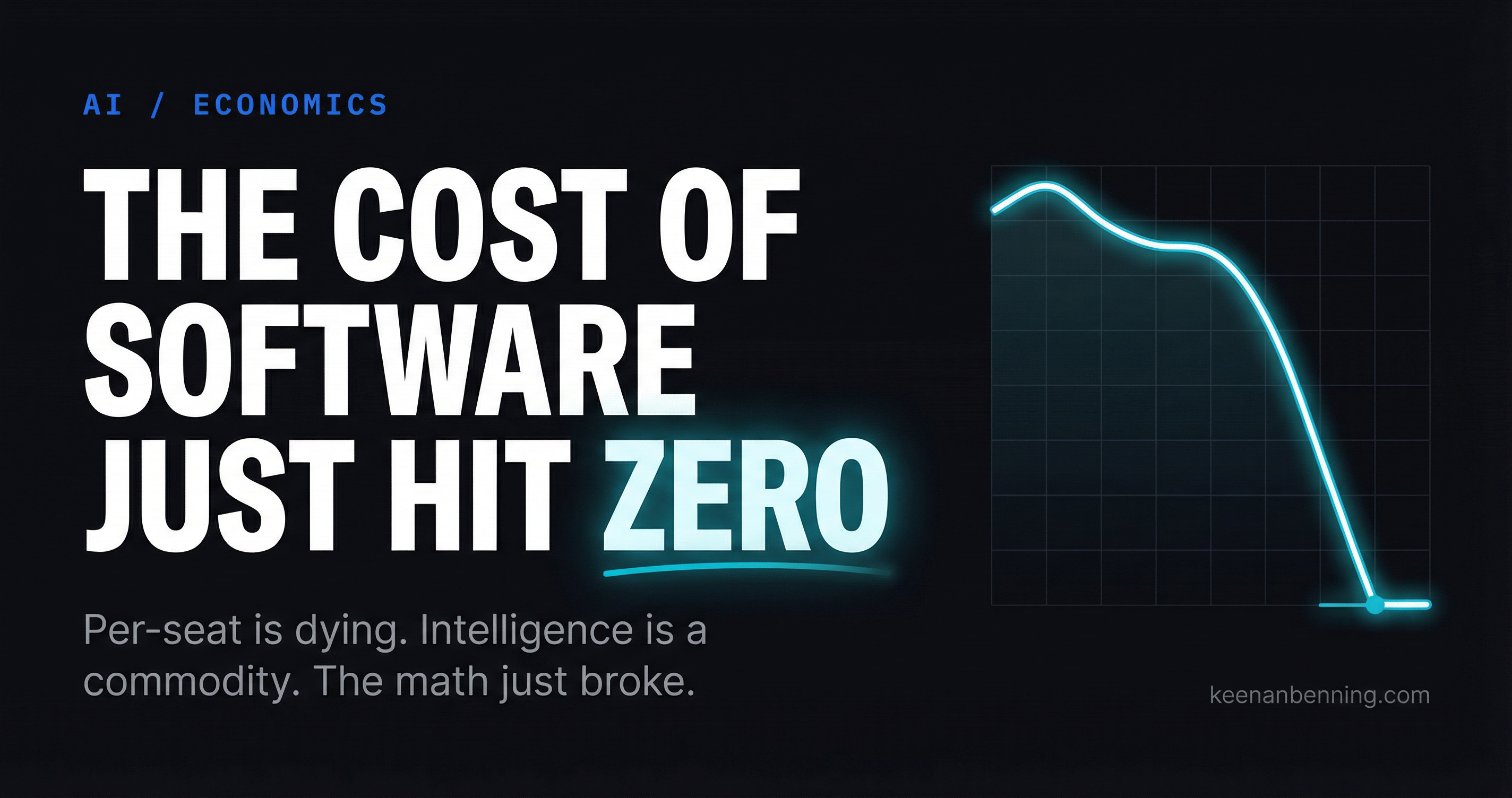
Charging for each software user is dying. AI is getting cheaper. I'm watching how this changes what we build, how we work and what people pay for.
Salesforce charges $300 per user per month. That model made Marc Benioff a billionaire and shaped how subscription software companies earn money from business customers.
AI agents just broke that math. These are AI systems that can use tools to carry out tasks, not just answer questions.
If one employee using agents does the work of ten, companies hire fewer people. Fewer people means fewer paid users, or seats. Fewer seats means less money for the software company.
Not because the customer left. Because they got more productive. Your product worked. Your revenue went down.
I've been watching these changes in how software gets built and sold.
KB
1. Per-seat pricing is dying
Business software is built around charging a company for each person who uses it. That's per-seat pricing.
Salesforce, Adobe, Slack, Jira, Figma. Every one of them prices by the seat. The logic made sense: more employees using the tool, more revenue. Sales grew with the number of employees.
Agents turn that around.
Klarna replaced 700 customer service reps with AI. Fewer people. The same amount of work. Wall Street cheered.
Every subscription software company selling into Klarna just lost 700 paid seats.
Multiply that across every large business on the planet and you see the problem. Customers aren't canceling. They're shrinking. And your revenue shrinks with them.
Whoever figures out how to charge for results or computing power used, instead of people, wins. The seat model is done.
2. AI is getting cheaper and easier to replace
Two years ago OpenAI had a six-month lead on everyone. That lead is gone.
Meta's Llama. Mistral. Alibaba's Qwen. DeepSeek. These models, which people can download and run themselves, aren't just catching up. On a lot of tests they're matching or beating the best models kept private by their makers.
The gap between what you pay for and what you can run yourself for free is collapsing every month.
A moat is an advantage that competitors have trouble copying. You can't build one just by putting a nice screen around an AI model anymore. The first wave of AI startups learned this the hard way. They added little to GPT-4. Investors put huge values on those companies. Their profit per sale shrank as the model got cheaper.
That story is mostly over.
And the AI providers aren't staying in their lane. When Anthropic shipped a Claude plugin for legal work, Thomson Reuters dropped 16% and RELX dropped 14% in a single day. One plugin. Two of the biggest legal tech companies in the world lost billions in stock-market value overnight.
The established companies are scrambling to figure out what others can't easily copy.
The big companies will eventually run these models on their own servers to keep data private and cut costs. Everyone else will rent. The companies that control that rental market become the new utilities.
"Our AI is smarter" is becoming a weaker reason to pay. The value is moving to how you assign work, give the AI the information it needs, and use what you know about the job.
The model is becoming something you can get from many suppliers. What you build around it is what matters now.
3. From doing each task to directing AI
The job is changing. It used to be doing the task. Now it's defining the task and checking whether the output is right.
I've been living this for over a year. Two platforms, one engineer.
I write a spec, a clear set of instructions: what the system should do, not how. The rules it must follow, unusual cases it must handle, what success looks like. Hand it to an agent. One pass. Full implementation. Then I verify the output against the spec.
The spec is the actual work. Writing code stopped being the job a while ago.
This is not a side project workflow. This is how I ship production software every day. One spec, a bug fixed in under an hour, deployed across four products. I didn't write a single line of the fix.
Anyone who writes reports, drafts contracts, creates designs or studies data can work the same way. Define the outcome, hand it to an agent, verify the result.
The field changes. The pattern doesn't.
The most valuable tools of the next five years won't be the ones that help you do each task faster. They'll be the ones that help you direct agents working at the same time.
Old tools were built for humans who do the work. The next generation is being built for humans who direct and check it.
4. Software is becoming disposable
Vibe coding started as a joke. It's now the fastest way to ship.
Describe what you want, AI writes the code, you review and adjust. What took a week takes an afternoon.
But the part most people haven't thought through is what happens when that's true for everyone. Not just engineers.
A marketing manager who needs a custom page to track results doesn't have to send a request to the tech team anymore. They describe what they want and get a working app in thirty minutes. A researcher who needs a tool to move and sort data for one project doesn't hire a contractor. They build it, run it once, throw it away.
Software as a tissue, not a product.
Think about who this hits. Tools that let you build software with little coding. Agencies charging $50k for a marketing site. Consulting firms billing $200/hour to connect software systems. Engineering teams that take six months to ship what one person with agents ships in a week.
When the cost of creation hits zero, the only value left is knowing what to create.
Where this lands
These four things aren't independent. They feed each other.
Per-seat pricing dies because agents reduce the number of people needed. AI becomes cheaper and easier to replace as more models catch up. Work shifts from doing every task to directing AI and checking the result. Software becomes disposable because generating it got nearly free.
Follow all of it to the end and you end up at the same place: the cost of building software is trending toward zero.
That changes what matters to anyone building, selling or investing in tech.
The value is moving away from writing software and toward directing systems that can do work on their own. Writing a clear brief for an AI agent is more valuable than being able to do the work by hand.
The moat isn't the code. It's the judgment behind it.
I've been building this way for over a year. Still figuring it out.
Agentic & distributed systems, DeFi, and the compute economics. One email a week, no fluff.
Subscribe to the newsletter →About the author
Keenan Benning is the founder of cYpher.camp, CTO of DeFi All Odds, and a forward-deployed AI systems engineer. He builds AI systems and writes about the engineering, economics, and ownership questions behind them.
Other projects